equa-logo

Study of a proposed design of an ice rink plant


1Project facts

Type: Sport, detailed studies
Consultant: EQUA
Client: PEAB
Summary: A detailed design proposal for an ice rink plant, where the excess heat is used for heating the building.

Challenge

In Sweden, the building regulations allows a building to be heated by excess heat from processes, if it in a satisfactory manner can be shown that it will work. In this case the excess heat is from chillers for ice preparation. To show that the building follows the building regulations, there was need for a detailed simulation model of the building and its plant.

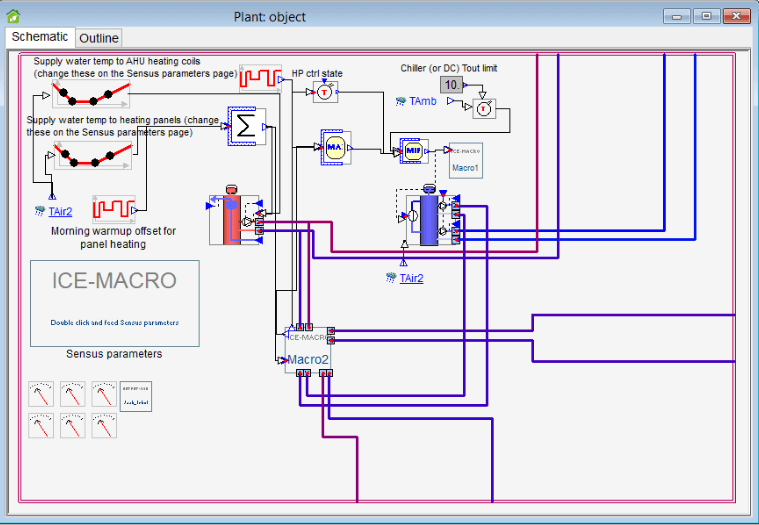
The plant, based around a CO2 chiller with the excess heat recycled in 8 steps using three groups of stratified tanks connected in a loop, had to be modelled in detail.

Solution

The building was modelled using IDA ICE with the Ice Rinks and Pools extension. The ice model was rewritten to take the hourly ice preparation of removing ice and applying water into account. As there was a detailed schematic of the proposed plant available, it was used to create the plant model with associated controls.

The plant model consist of the CO2 chiller and recycling of the condenser heat in 8 steps; (1) final heating of hot water, (2) heat for dehumidifying, (3) heat to room heaters, (4) hot water to ice preparation truck, (5) heating for ventilation, (6) melting of excess ice, (7) pre-heating of hot water, (8) heat of the ground below the ice to avoid freezing. If the temperature after all this recycling is still higher than + 25 ° C, the heat is removed by a heat rejection coil in the relief air stream of the air handling unit.


The concept of decoupling was applied; one parent model containing the central HVAC-systems and five child models containing one or two storeys and their zones. Each child model was run on a separate processor to increase simulation speed. To achieve balanced air flow in the VAV-system the exhaust air from the mall concourse was modelled as a pressure-controlled system with leaks between the shops and the concourse.

1
2
Result

The net total energy use simulated was 78 kWh/m2. The average value for ice rinks in Sweden is 264 kWh/m2 (year 2009). The model also made it possible to rise warnings about a few possible problems with the design:

  • There is a risk that the chillers can’t deliver the heat needed during the coldest period. If the air temperature above the pitch gets lower, the chiller will produce less heat which may cause a negative spiral of too little heat produced. This can be prevented by turning on the lights above the pitch during cool nights.
  • In the proposed design of the air handing system, a coil for heat rejection of excess heat from the chiller was used in a way that there were risk of unnecessary ventilation of the building by moist air. The simulations led to a suggestion to change the design.


logo equa     peab     
 

Print Email

Hybrid (mechanical and natural) ventilation of a school building


1
Project facts

Type: Educational, whole-building studies
Consultant: EQUA
Client: Betic
Summary: A mechanical and natural ventilation system in a schoolhouse is improved by introduction of a well-designed control system.


Challenge

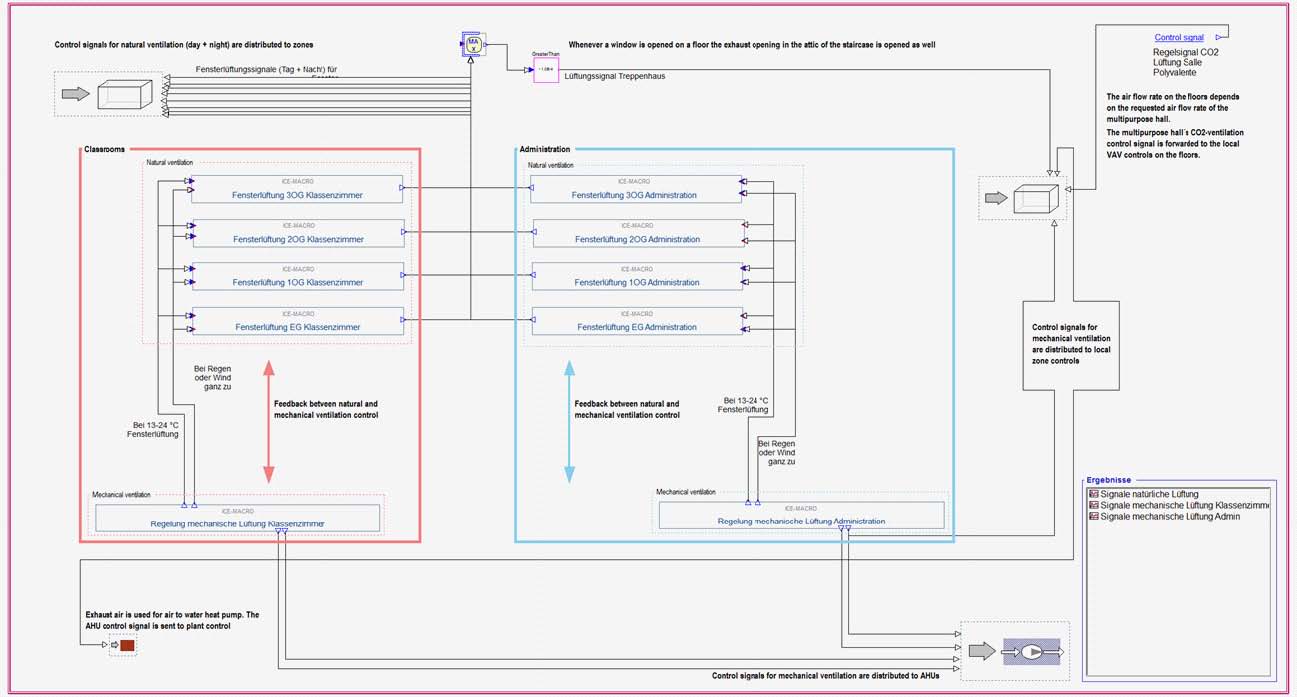
Each corridor on every floor of a zero energy schoolhouse is connected to a central staircase. All classrooms and offices are supplied with air directly from the adjacent corridors by use of fans. Depending on various control strategies the corridors are either ventilated naturally or mechanically. The central staircase works as an exhaust duct for both natural and mechanical ventilation.

With no active cooling and only reheat coils in the supply air, pleasant room temperatures and air quality must be maintained whenever a classroom or office is occupied. However, slightly lower temperatures are accepted in the corridors and the staircases.

Solution

A key feature to this ventilation concept is a building control system which takes into account all the interactions between various control strategies, the plant, the building, air flows inside of the building and not least the building occupants.

Most of the local controls are fed back to the central building control. Some of the most important local macros in turn control:
  • Storey-wise window ventilation of the corridors according to ambient air temperature, rain and wind, the CO2 content in the corridors, occupancy and ventilation need on all other floors.
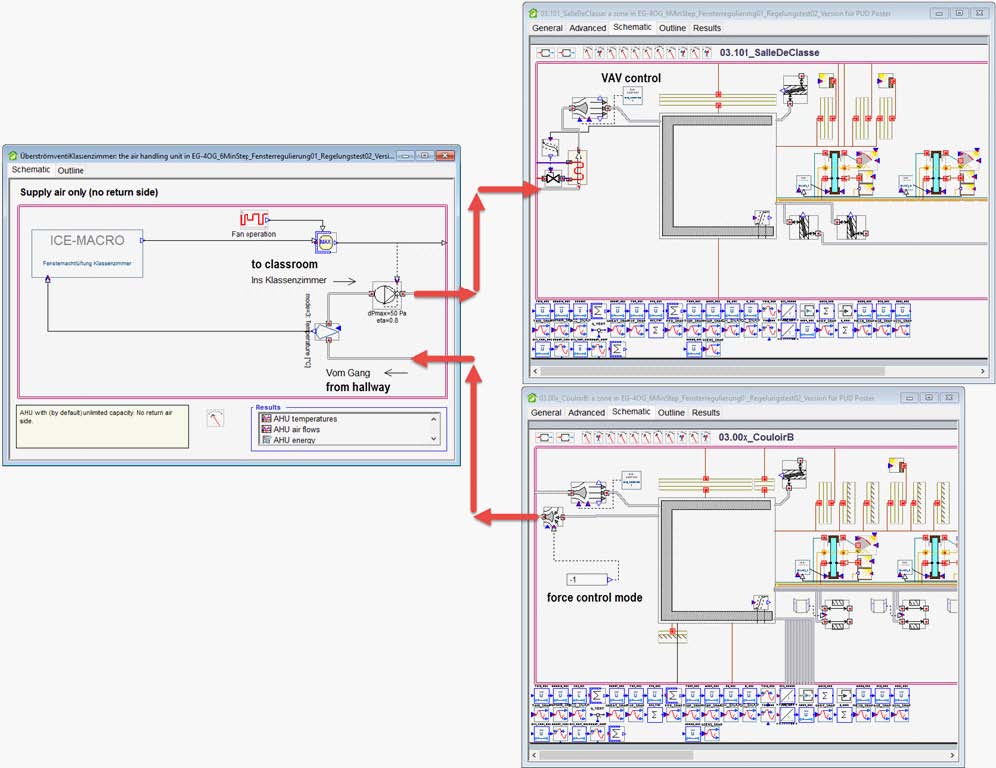
  • Overflow fans between corridors and classrooms according to occupancy, room air temperature (for day and night cooling).
  • Storey-wise mechanical supply airflow rate for corridors on each floor according to ambient air temperature, rain and wind, occupancy, CO2-Level, air demand of all other floors and occupancy in multi-purpose hall.
  • Heater convectors in overflow fans (only possible when fans are in operation) according to zone air temperature.
  • Heat recovery in the central AHUs according to air and supply air temperature.

 
To minimize work on the Advanced Level, fans between corridors and classrooms where modelled with central AHUs.
2
3


Result

The model was used to:
  • Verify and improve the control strategies for ventilation, heating coils and the plant.
  • Adjust the window opening size for natural ventilation.
  • Size a number of building services, such as an air to water heat pump and the reheat coils.


logo equa     betic logo     
 

Print Email

Model-based planning of ice preparation in a multi-purpose arena


1Project facts

Type: Sport, detailed studies
Consultant: EQUA
Client: SGA Fastigheter
Summary: A multi-purpose sports arena with a seating capacity of 30 000 spectators needed a strategy for ice preparation. A detailed model was created and calibrated towards measurement.


Challenge

Tele2 Arena in Stockholm is a multi-purpose sports arena with a seating capacity of 30 000 spectators. Typical events include football games and music concerts. The arena also has the capability to freeze an ice bandy rink. Pipes circulating low temperature brine are immersed in the concrete slab below the open space pitch.

The time for switching between different events is crucial. Evaluating different strategies of ice preparation in practice is time-consuming and expensive. A model for testing different options would certainly be useful. The challenge of simultaneously model the arena space, the HVAC system, the chillers, the brine loop and phase changing surface is big.

Solution

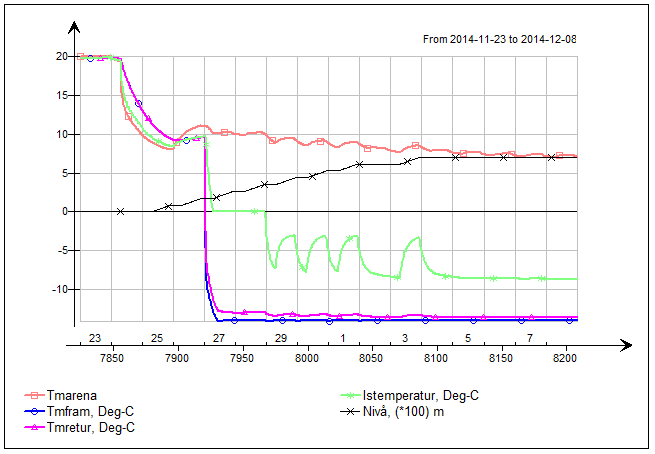
EQUA was engaged to design a model and to calibrate it towards measurement of the arena space temperature, the ice temperature and the brine supply and return temperatures. Time series covering a period of more than a month and including ice preparation exercises was used.
The model included both the arena space, divided into three zones in horizontal direction and ambient zones, the HVAC system serving the arena space, the chillers, the brine system including the dynamics of the concrete slab and the water/ice surface. The component model of the combined water and ice surface was adjusted to account for the gradually increase of water on the pitch.

2


Result

The calibrated model was used to:
  • Investigate the total time of ice preparation for various initial conditions, supply brine temperatures and brine flow rates.
  • Investigate the arena air temperature and ice temperature during a sold out ice bandy event with design loads.
  • Predict a reasonable ice preparation schedule including time for supplying water and painting the lines.

3


logo equa     sga logo     
 

Print Email

Evaporative cooling of a building envelope


0a

Project facts

Type: Industrial, Detailed studies
Consultant: EQUA
Client: University of Stuttgart
Summary: Evaporative cooling study of a factory envelope. A tailor-made extension for IDA ICE was developed and used. Comparison between measurement and simulation showed very good agreement.


Challenge

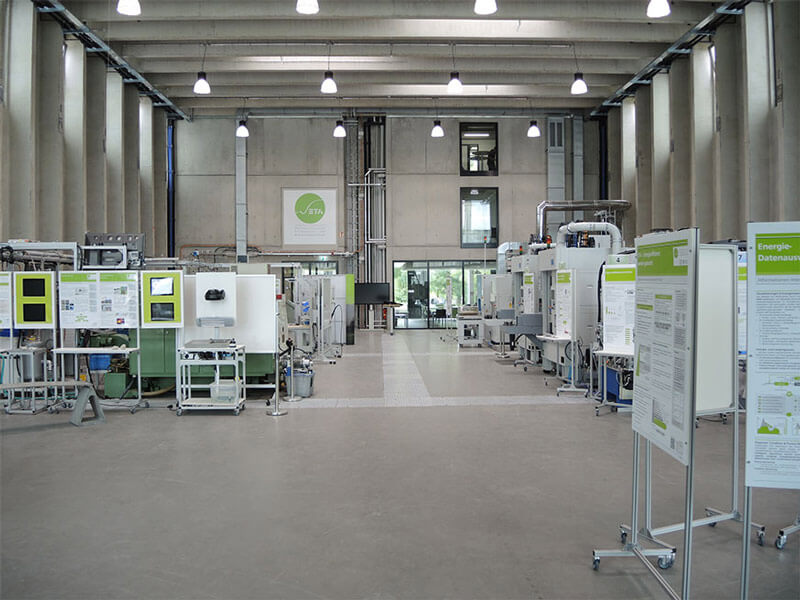
The work was carried out in the context of the German research project ETA-Fabrik (ETA - Energy Efficiency, Technology, Application Center).

eta fabrik 800
The ETA Fabrik


Its aim is the construction of a model factory with greatly enhanced efficiency through a combined planning of the subsystems ‘building’, ‘technical infrastructure’ and ‘machinery’. The project team included 36 partners from industry and research. In the factory, exhaust heat from the machines is transferred via a water flow to capillary pipes that are located in the building envelope. The envelope is then adiabatically cooled during the day by spraying it with rainwater. Overnight the envelope is cooled through longwave radiation.

principle 800
The principle behind the envelope of the ETA Fabrik

IDA ICE, the building simulation tool chosen to support the project, could however not model the adiabatic cooling process out-of-the-box.

Solution

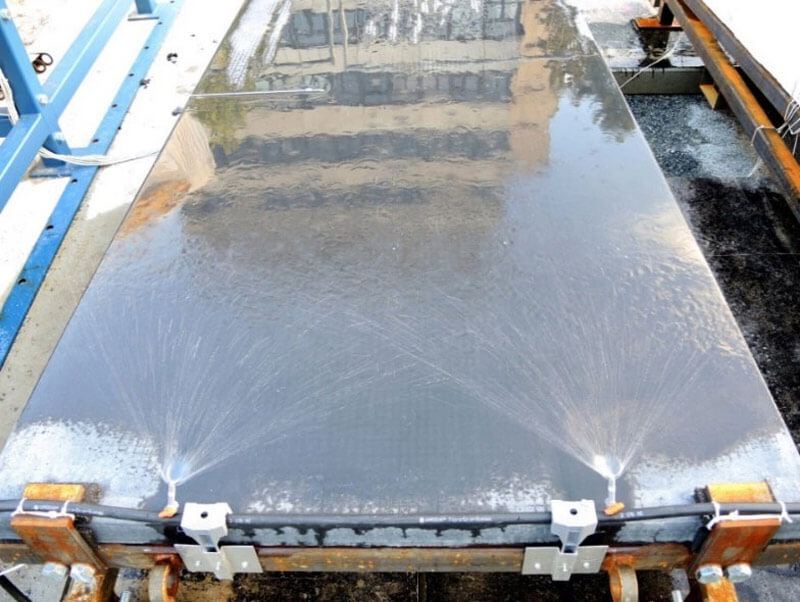
The project partner University of Stuttgart, Institute of Construction Materials approached EQUA to develop a solution for the problem. The initial approach was to use the IDA ICE extension Ice Rinks and Pools, since it considers evaporative processes. It initially showed promising results but had the limitation that the evaporation could not be controlled (the building envelope of the ETA Fabrik is not continuously humidified, but the humidification is turned off when not needed to save water). EQUA therefore developed an extension that could model a non-continues humidification of an external building surface and quantifies the energy flows associated with the evaporation of the water and the cooling potential this generates. This extension was then incorporated into an IDA ICE model and the simulation-based performance predictions compared to measurements from a test rig.

berekningsmodul 800

The extension implemented in an IDA ICE model
humidification 800
The humidification test rig

Result

The comparison between measurement and simulation showed a very good agreement. This validation was important since the implementation contained certain simplifications. For instance is in reality the humidification modulated in intervals of several minutes whereas the evaporation in the model was assumed to be continuously.

evaporative resultat 800

Measured and simulated performance with and without humidification

With the good agreement it was concluded that the implementation was sufficiently accurate to interrogate different design scenarios, for instance the simulation of the entire ETA-Fabrik building or the evaluation of the impact of different supply temperatures for the envelope humidification.


logo equa
 

Print Email

Fennia Office Building, Helsinki


fennia 800

Project Information:

Type: Office, detailed studies
Consultant: EQUA
Client:Are Oy
Summary: Retrofit of office building with high U-values (thermal resistance). Ceiling heating/cooling panels, integrated to Sensus-system, were carefully dimensioned and positioned, resulting in improved comfort and 25-35% energy savings compared to the tradition system.


Challenge

The aim of the study was to use radiant ceiling heating/cooling panels in a renovation project with relative high window and envelope construction U-values. The ceiling panels were integrated to the Sensus-system, which is developed by Are - one of the largest HVAC (Heating, Ventilation and Cooling) contractors in Finland. The system suitability and possible energy savings were explored to calculate effective results.
In the Sensus-system the internal heat gains from the water based cooling panel network are used in AHU (Air Handling Unit) supply air heating with simultaneous free cooling effect to zones.
The system is controlled with developed special automation system with several control circuits and valves.
The challenge was to attain comfort summer and winter time indoor conditions with none replaced windows (U=2.0 W/m2K, g-value 0.62), and fair and reliable energy use comparisons between the traditional system and Sensus.

Read more information about Sensus system


Solution

Special attention and care with heating/cooling panel sizing, panel positions in spaces, and optimal panel surface area in order to fulfil indoor climate requirements. Avoiding additional costs of a studied system with precise component dimensions and careful load simulations against manufacturer design data.

fennia solution
Modeled office building floor and nearest surrounding buildings causing shading to windows


fennia plant
Plant general view. Pipe connections were done with PMTMUX-objects within special macro


Energy savings were achieved mainly by the following improvements compared to the traditional system:

  • Optimal free cooling with simultaneous heating to supply air from internal gains
  • Optimal night ventilation/free cooling/night cooling usage
  • CO2 and temperature based demand ventilation. In temperature based control the free cooling via cooling panels was used before the VAV (Variable Air Volume) control to attain optimal energy usage
  • Using night setback with variable heating setpoints and effective morning warmup


Result

Proper dimensioning of the required indoor climate conditions were fulfilled with the studied heating/cooling panel system. Because of the high heating needs, at some locations of the building with high windows, water radiators were used instead/additionally with the panels. The water radiator network was already used/present because of secondary space use, so there was an existing network to connect the radiators.


Compared to traditional system Sensus system provided:

  • 25% computational heating energy savings in simulated office (only) spaces calculated without the DHW (Domestic Hot Water) usage
  • Regarding the same simulated spaces - 35% computational energy savings in district cooling energy


logo equa
 

Print Email