 Deutsch
 English
 Svenska
 Suomi
 中文(简体)

Highlights in IDA Districts 1.0.1
Learn more about IDA Districts
 New and Updated Network Templates
Low-Temperature Network – Meshed Networks and Dynamic Energy Supply
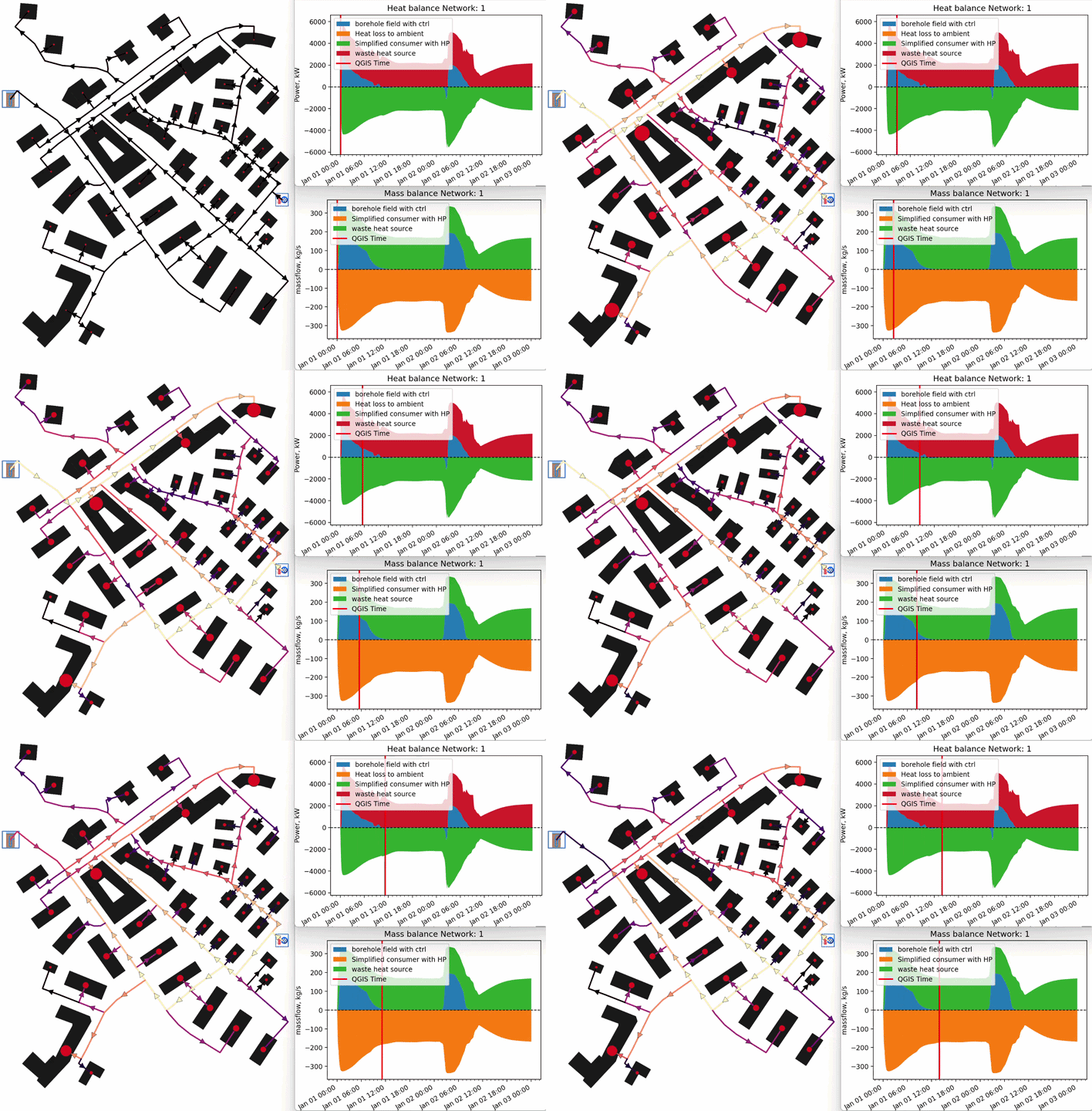
Purpose: Extension of the existing low-temperature network template with additional network configurations, meshed topologies and multiple energy plants. Three different configurations are now available. The new third configuration introduces a meshed network with two energy plants that are dynamically controlled according to network demand. Waste heat integration has also been added, and PE pipes can now be selected from the database.
Usability: Provides greater flexibility for investigating different network configurations and analysing the interaction between multiple energy plants within a single simulation model. The extended templates offer a practical starting point for modelling more complex low-temperature and ambient energy networks.
Example: Simulation of a meshed low-temperature network with two energy plants whose operation dynamically responds to changing heating and cooling demand. The integration of available waste heat can also be investigated.
Secondary Network – Simulating Interconnected Energy Networks
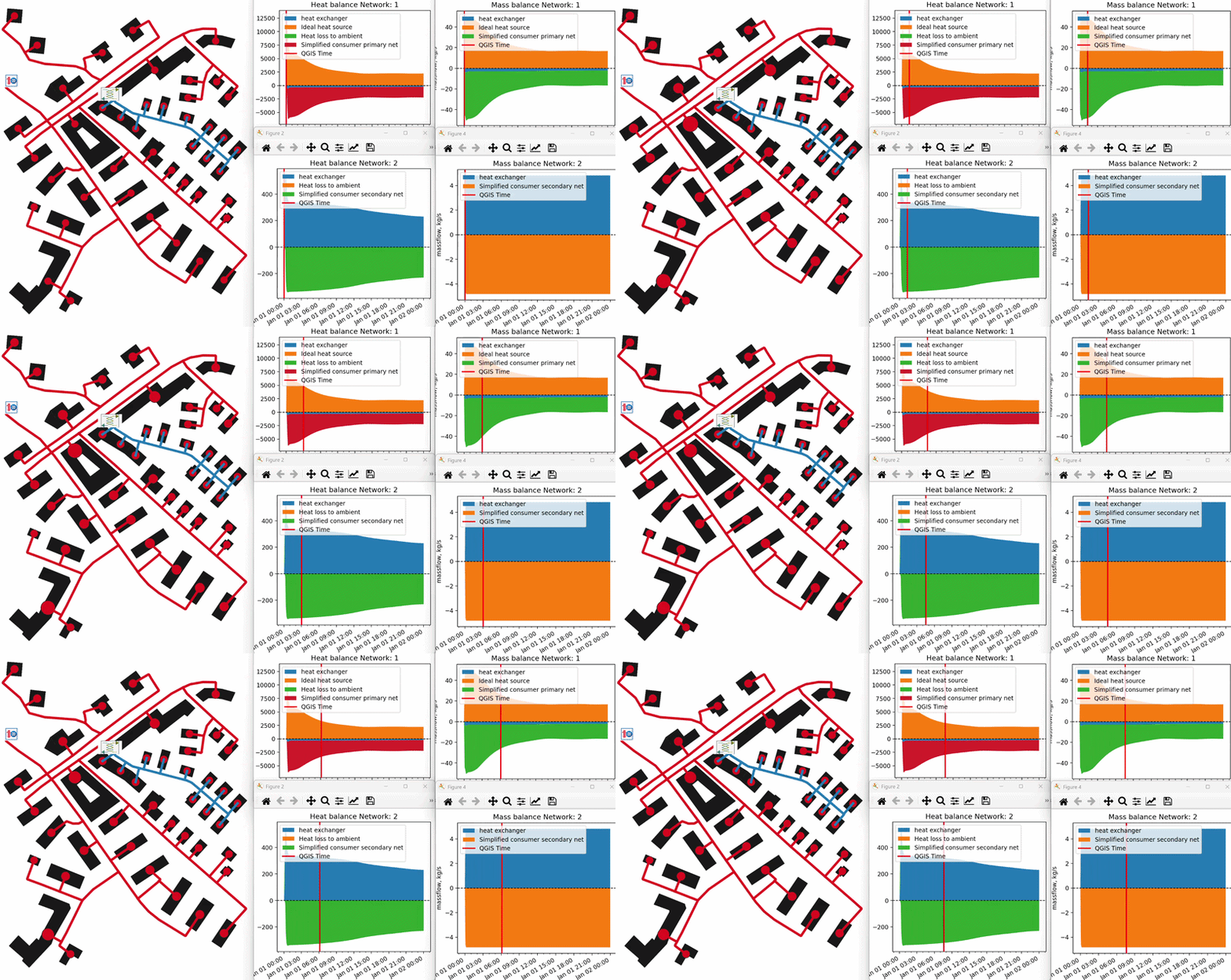
Purpose: New network template demonstrating the interaction between a primary and a secondary district energy network within a single simulation model. Both networks are hydraulically separated by a heat exchanger, allowing energy transfer between different network levels.
Usability: Simplifies the modelling of hierarchical thermal distribution networks. The template allows users to investigate the dynamic interaction between primary and secondary networks within a combined simulation.
Example: A primary district heating network supplies a secondary district network through a heat exchanger. Energy transfer and the dynamic effects of varying load conditions can be analysed within one model.
Heating & Cooling Network – Combined Energy Supply
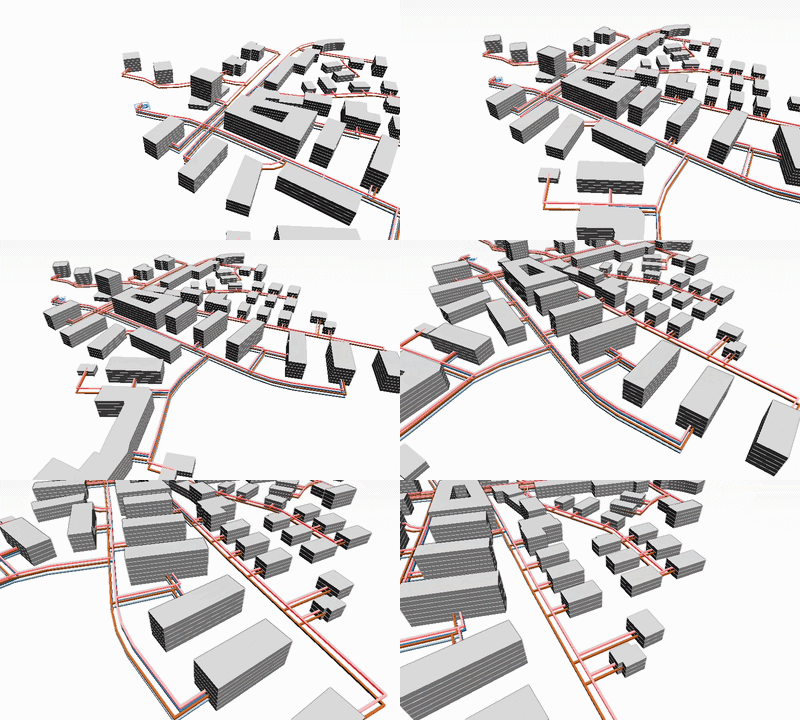
Purpose: New template combining a district heating network and a separate district cooling network within one integrated thermal energy system. The cooling network has a smaller capacity and network size compared to the heating network.
Usability: Enables the dynamic simulation of different distribution infrastructures within a shared model and provides a starting point for analysing combined heating and cooling concepts.
Example: Simulation of a district with a heating network supplying space heating and a separate cooling network serving selected buildings with cooling demand.
Heat Pumps and Hydraulic Components
Reversible Heat Pumps and Chillers – CarnotHpChillerIdealFlow
Purpose: New substation component for combined heating and cooling operation. Performance is based on Carnot efficiency combined with a configurable real efficiency. Depending on the operating mode (heat pump or chiller), the required mass flow is automatically calculated from the current heating or cooling demand. Two reversible pumps provide flow from the supply or return line as required. The calculated mass flow is maintained under ideal flow conditions.
Usability: Simplifies the modelling of reversible heating and cooling concepts and reduces the need for manually calculating and specifying demand-dependent mass flows.
Example: A substation in a low-temperature network switches between heating and cooling operation depending on building demand, with mass flows automatically adjusted to the operating mode.
Bidirectional Flow Control – Bi2UniSwitchValve
Purpose: New valve component that converts bidirectional flow into controlled unidirectional flow. A control signal determines the active flow direction and corresponding flow path.
Usability: Facilitates the modelling of hydraulic configurations with changing flow directions and allows controlled routing of flow within a thermal system.
Example: A hydraulic circuit in which the flow direction changes depending on the current heating or cooling operating mode.
Air-to-Brine Heat Pump – HP_A2B
Purpose: New heat pump model using ambient air as its heat source and a brine circuit on the secondary side.
Usability: Extends the available heat pump configurations and supports the integration of air-based heat sources into thermal supply systems with brine circuits.
Example: Simulation of an air-to-brine heat pump within an energy plant supplying heat to a brine circuit.
Geothermal Energy and Borehole Fields
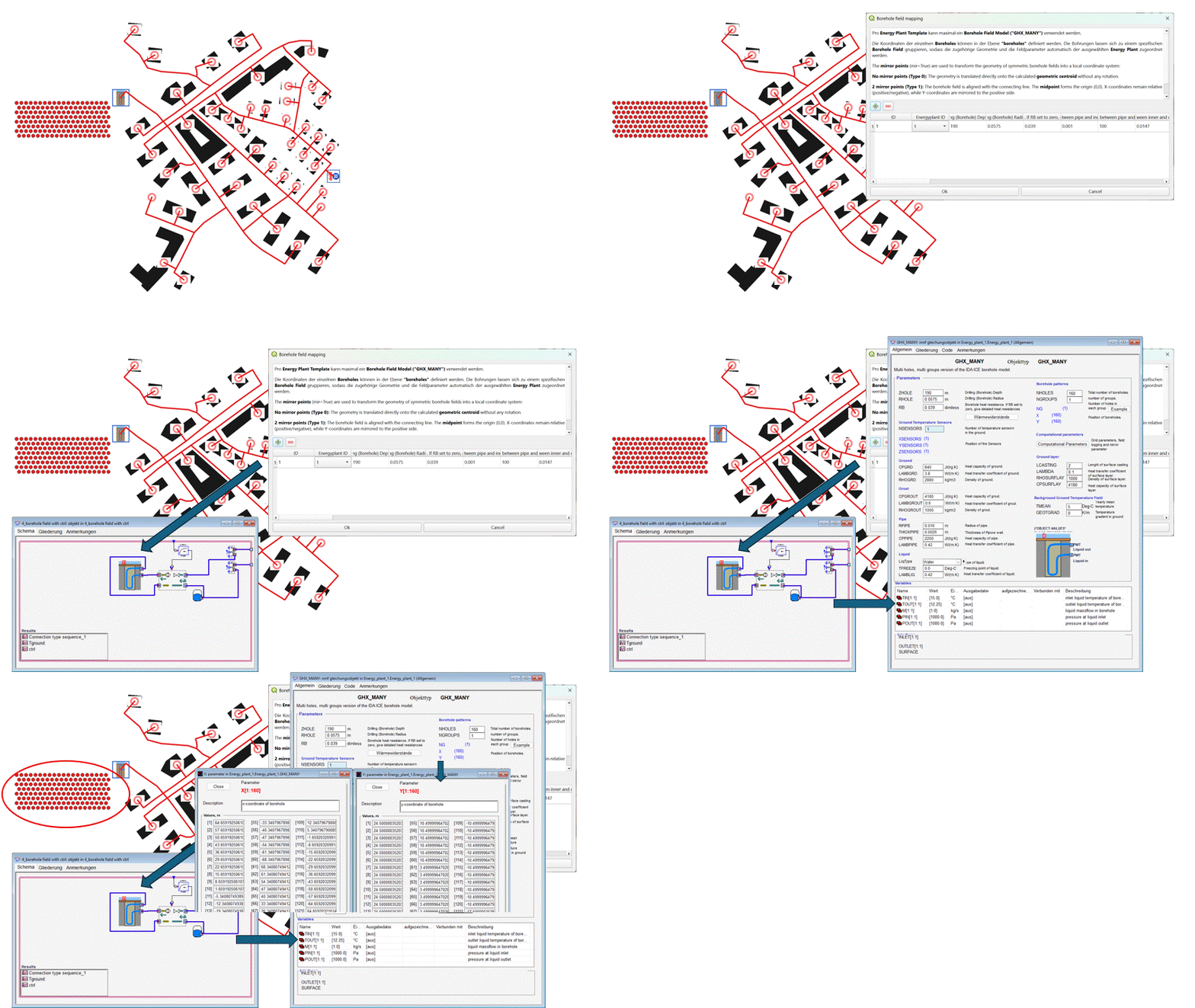
Three-Dimensional Borehole Field Simulation – GHX_Many
Purpose: New three-dimensional ground heat exchanger model for simulating a wide range of borehole field configurations. The model supports arbitrary arrangements of vertical and inclined boreholes of equal length. It accounts for thermal interactions between individual boreholes, undisturbed ground temperature, climatic temperature variations and the geothermal temperature gradient.
Usability: Enables detailed investigation of complex borehole fields and their thermal interactions within a single simulation model. Several symmetry options can reduce computational effort, while additional temperature variables provide detailed insights into ground temperature development and conditions at individual borehole locations.
Functionality: The calculation is based on the superposition of cylindrical two-dimensional temperature fields around individual boreholes. A one-dimensional vertical ground temperature field represents the undisturbed ground temperature and geothermal gradient. The computational domain includes prescribed temperature boundary conditions at the top and bottom and an insulated outer boundary.
Example: Simulation of a borehole field with differently arranged vertical and inclined boreholes. The model can be used to investigate how the thermal loading of individual boreholes influences surrounding ground temperatures and neighbouring boreholes.
Available temperature variables:
- TUnDist: Undisturbed ground temperature including geothermal effects
- DTref: Temperature variation caused by climatic conditions
- DT: Temperature change caused by an individual borehole
- DTSum: Combined thermal influence of surrounding boreholes
- TReal: Actual ground temperature at borehole locations
- T: Temperature field within a user-defined calculation plane
Control and Mathematical Functions
New Mathematical Component – pow
Purpose: New mathematical component that raises an input signal to a configurable exponent. It allows custom mathematical relationships to be implemented directly within a simulation model.
Usability: Extends the possibilities for developing customised control strategies and nonlinear mathematical functions without requiring more complex combinations of existing signal-processing components.
Example: Implementation of a nonlinear control characteristic in which an input signal is processed using a configurable power function.