CFD
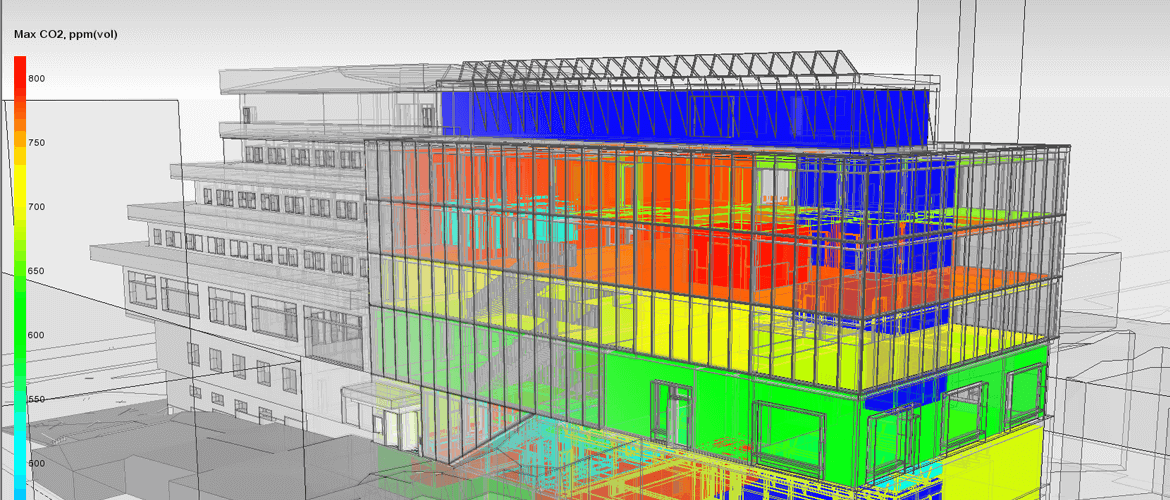
The CFD (Computational Fluid Dynamics) extension for IDA ICE enables detailed simulation of airflows and temperature distributions within buildings.
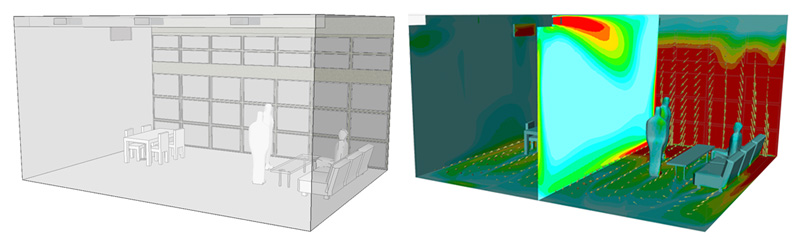
The CFD extension, which connects to and uses OpenFOAM®, provides insights into indoor climate performance that go beyond traditional zone-based modelling methods in IDA ICE. Integrated with the IDA ICE environment, CFD simulations can be launched directly from existing building models. This ensures consistent geometry and boundary conditions, delivering results that accurately reflect the indoor environment. The tool allows engineers to assess HVAC strategies, occupant comfort and energy performance within a single, coherent workflow.
Example of Applications
- HVAC design evaluation
A cost-effective CFD tool that allows HVAC engineers to test and compare design alternatives before construction, offering insight into how multiple factors interact to influence comfort, air quality and energy performance.
- Comfort and air quality in office and meeting rooms
Visualize draught rate, age of air and stratification across spaces, and compare different ventilation strategies.
- Cold draught
Assess the impact of cold surfaces such as glass roofed halls, glazed façades or showrooms, identifying potential discomfort.
- Buildings with repetitive layouts
Evaluate thermal comfort and draught rate at detailed room level in hotel rooms, apartments or offices before large-scale implementation.
- Irregular shaped or obstructive spaces
Analyse airflow patterns in atria (atriums), concert rooms or similar, where the three-dimensional air movement due to ventilation and buoyancy may influence comfort and air quality.
- Industrial buildings
When strong internal gains may generate complex interactions with ventilation, CFD may be the only viable tool for analysis and problem solving.
- Kitchens, cleanrooms, laboratories
Perform advanced and cost-effective pre-studies where air velocity, temperature distribution and ventilation efficiency are of central importance.
- Detailed input for thermal comfort
Generate accurate air velocity and temperature data around occupants, improving predictions beyond simplified assumptions.
- Air velocity and temperature distribution in connected spaces
Simulate airflow through doors, corridors, staircases or openings to visualise temperature and velocity patterns between connected spaces.
More about the CFD extension
The CFD extension is designed to make flow simulations a natural part of the building design process. By providing a direct interface between the IDA ICE building model and a validated CFD solver, it enables rapid iteration and visual analysis without the need for external CFD specialists.
Using advanced CFD methods provided by OpenFOAM®, the extension resolves three-dimensional air movements, temperature gradients, draught rate and age of air within rooms and connected spaces. This detailed analysis improves simulation accuracy, enhances understanding of indoor climate behaviour, and provides a sound basis for verifying design choices when simplified models are insufficient.
The rich 3D visualisation of CFD results also strengthens communication, helping engineers, architects and clients clearly see the impact of design alternatives and make better-informed decisions.
Trademark disclaimer
OPENFOAM® is a registered trademark of OpenCFD Limited, producer and distributor of the OpenFOAM software via www.openfoam.com.
This offering is not approved or endorsed by OpenCFD Limited, producer and distributor of the OpenFOAM software and owner of the OPENFOAM® and OpenCFD® trademarks.
Details:
- Available as extension for the Expert edition
- Requires IDA ICE version 5.1.1 (or higher)
|
Print
Email
 English
  Svenska
  Deutsch
  Suomi
Suomi  中文(简体)