 Simulation & Analysis
Sunlight Exposure EN 17037
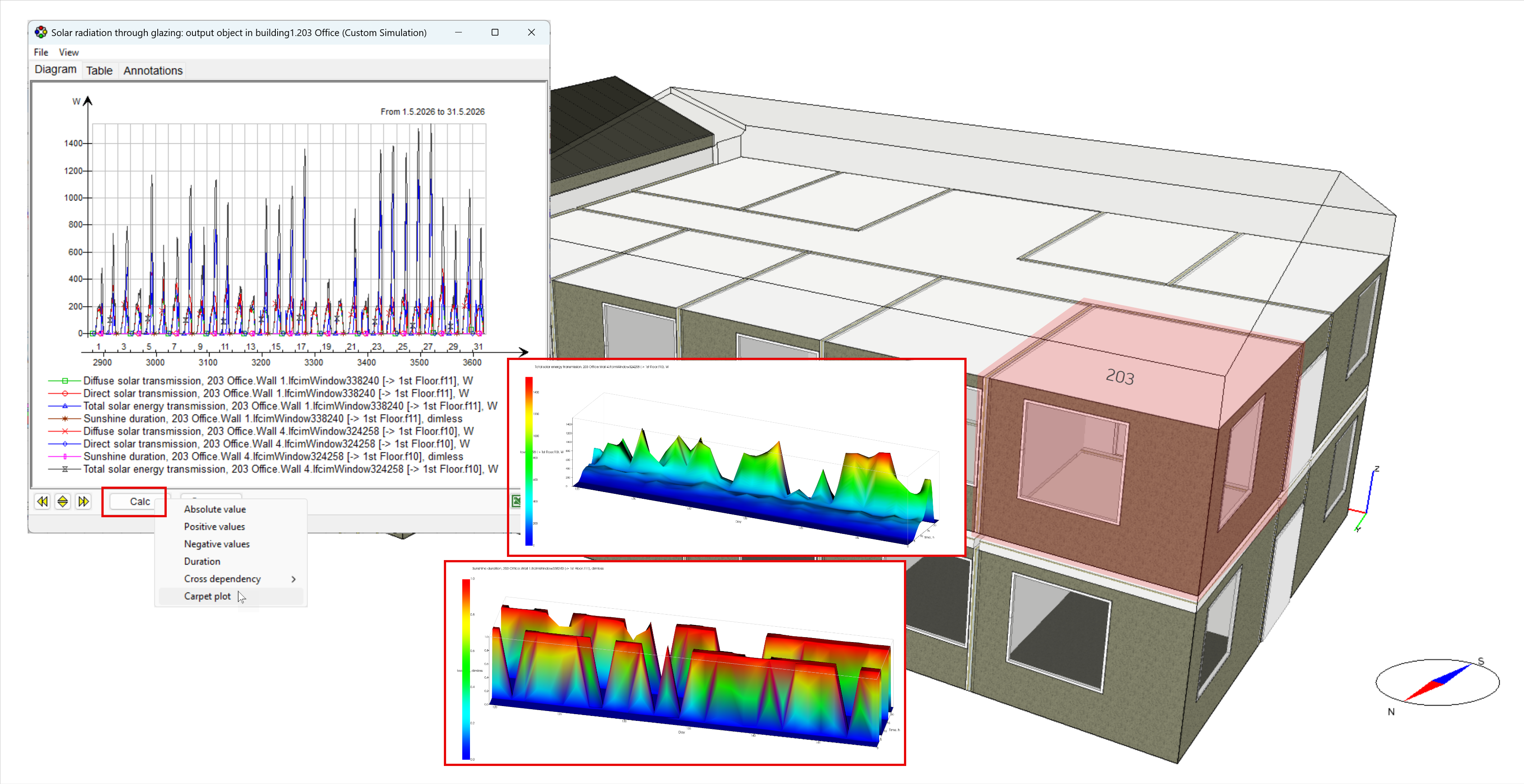
Purpose: Evaluate the duration of direct sunlight exposure on individual windows and verify sunlight requirements according to EN 17037.
Ease of use: Direct sunlight presence is available as a simulation output from “Solar radiation through windows” and can be converted into a duration plot, making it easy to assess and compare sunlight exposure across windows.
Local Thermal Discomfort ISO 7730
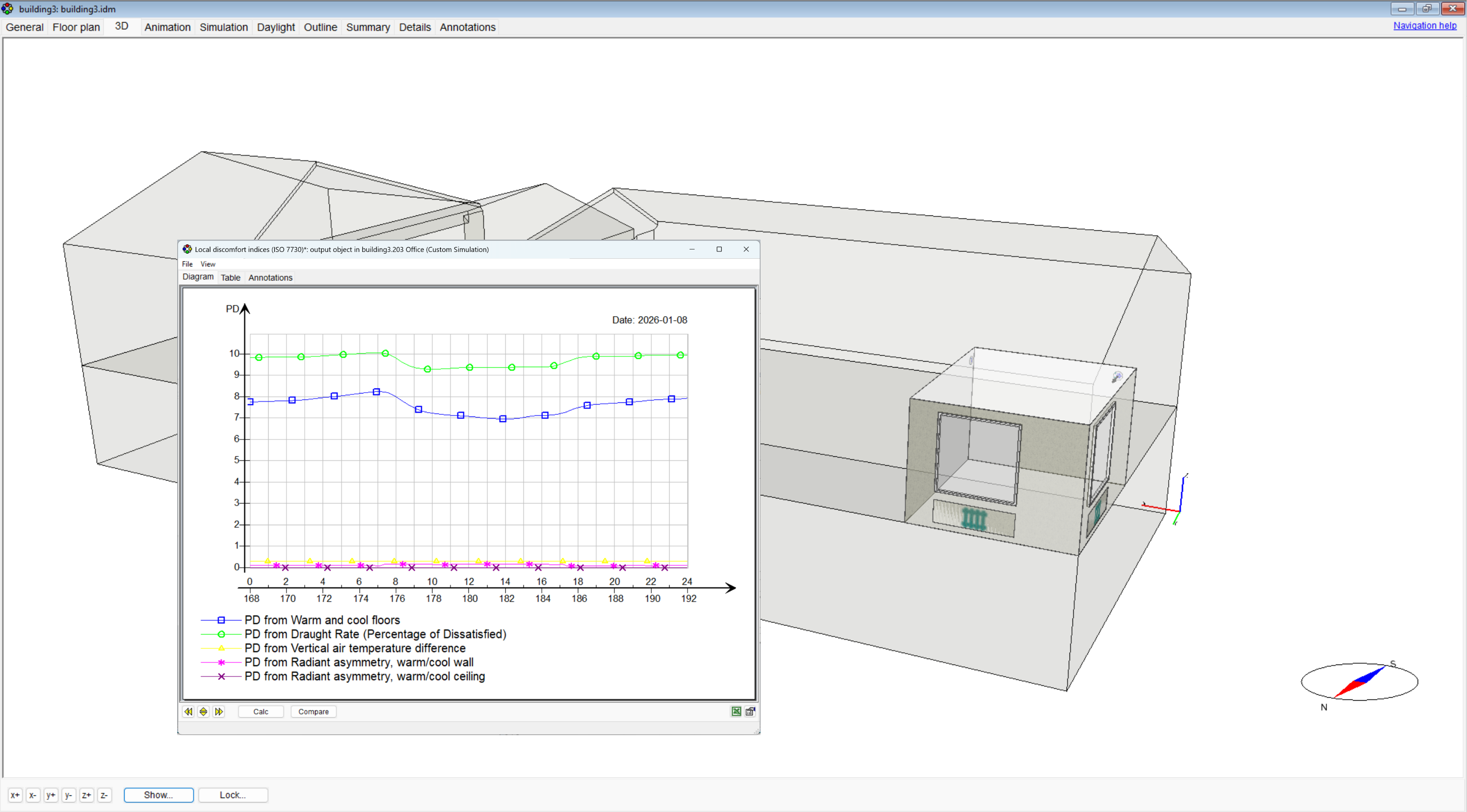
Purpose: Evaluate local thermal discomfort with the stratified zone model using ISO 7730 criteria, including draught, floor temperature, vertical air temperature difference and radiant temperature asymmetry.
Ease of use: Provides percentage dissatisfied (PD) outputs directly from spatially resolved air and radiant conditions, enabling detailed local comfort assessment without additional calculations. In addition, the model computes long-wave radiative exchange using detailed view factor calculations between room surfaces and occupants, allowing radiant temperature asymmetry to be evaluated correctly even for complex room geometries.
Example: Assess local discomfort in an office during a winter design day, including draught from supply air and discomfort caused by cold windows or surfaces.
Controllable Shading in Daylight Simulation
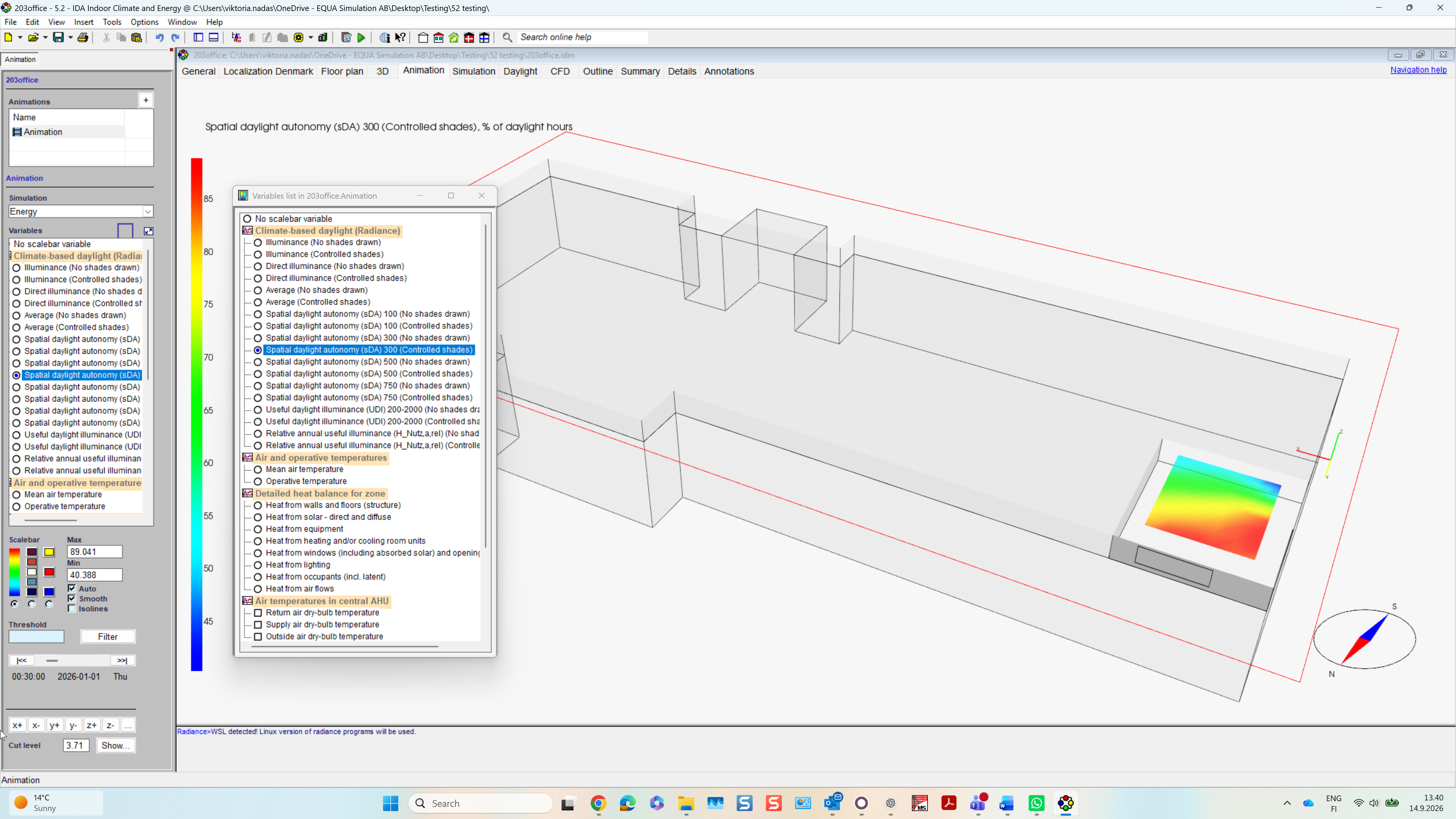
Purpose: Include controllable shading in climate-based daylight simulations using the shading operation determined by the preceding thermal simulation, reflecting the actual shading operation.
Ease of use: Daylight metrics automatically account for actual shading operation, providing more realistic results and supporting daylight assessments required by building certification schemes.
Example: Evaluate annual daylight performance in an office where solar shading responds dynamically to changing indoor and outdoor conditions.
Smoothing by Simulation Type
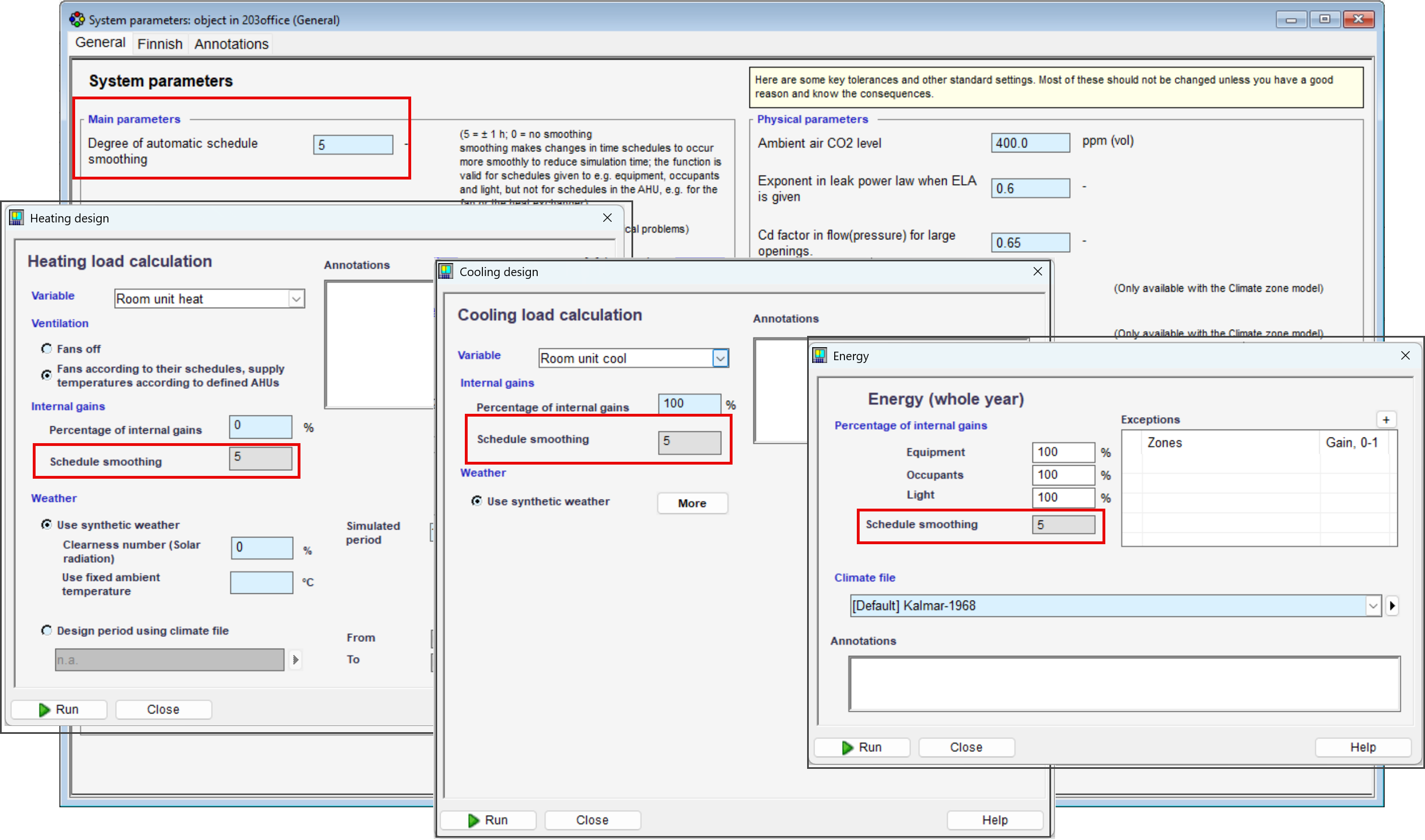
Purpose: Control schedule smoothing separately for different simulation types, allowing the same model configuration to be used for different simulation purposes.
Ease of use: Apply smoothing where it improves result interpretation, such as energy simulations, while keeping it disabled for analyses where unsmoothed inputs are preferred, such as heating load calculations.
Example: Use smoothing for annual energy simulations while keeping continuously varying occupancy schedules unchanged for heating load calculations.
Improved ISO 13370 Ground Model
Purpose: Improve ground heat transfer calculations according to ISO 13370 by distinguishing between zones at the building perimeter and zones within the building footprint.
Ease of use: Ground temperatures are automatically calculated according to zone position, providing a more accurate representation of ground heat losses without additional model setup.
Example: Simulate a large building where perimeter rooms experience different ground heat transfer conditions than rooms located in the center.